
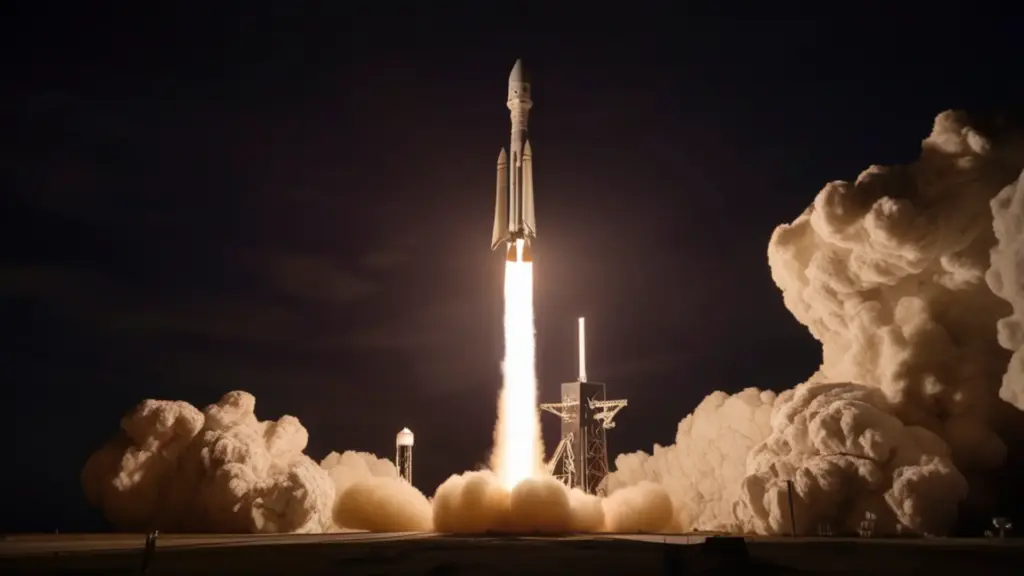
THE MOMENT
Donald Trump is moving U.S. Space Command from Colorado to Alabama. Washington is taking the sign off the door — but they cannot take our scientists, our launch contracts, our universities, or our 55,000 aerospace workers. Colorado is the space state, with or without their permission.
While they pack the moving trucks, Colorado will do something no state in America has ever done: build and fly its own space program.
You don’t need to be a billionaire to reach the stars. You just need to be a Coloradan.
Bezos has Blue Origin. Musk has SpaceX. Branson has Virgin Galactic. Coloradans deserve a space program that works for us — for our kids, our schools, our workers, our communities — not for one man’s ego.
THE VISION
The Colorado Space Initiative (CSI) — a state-chartered authority that builds, owns, and flies Colorado missions. Not a sponsor. Not a grant maker. A mission operator.
Texas hands out grants. Florida sticks state data on someone else’s lander. Colorado will plant its flag on the Moon — physically, with a Colorado-built spacecraft, on a Colorado-owned mission.
We will be the first state in American history to do it.
WHY COLORADO — WHY NOW
We are not starting from zero. We are already the #2 space economy in America, behind only California:
- 2,000+ aerospace companies statewide
- $23 billion in annual federal aerospace contracts
- 55,000+ aerospace workers
- 50% of the U.S. Space Force based here
- CU Boulder’s LASP — the only academic institute on Earth to send instruments to all 8 planets, Pluto, and beyond. $200M+ annual budget. 26 active space missions.
- Lockheed Martin Jefferson County — builds the Orion spacecraft taking astronauts back to the Moon
- BAE Space (formerly Ball Aerospace) — prime contractor on the James Webb Space Telescope optics
- United Launch Alliance — Vulcan rocket operations
- Sierra Space Louisville — Dream Chaser spaceplane
- CSU Walter Scott Jr. College of Engineering — atmospheric science, satellite remote sensing
- U.S. Air Force Academy — top-5 nationally ranked aerospace engineering program
Colorado already builds spacecraft. We just don’t fly them as Colorado missions. CSI fixes that.
"COLORADO ONE" — THE FLAGSHIP MISSION
By the end of Governor Underwood’s first term, Colorado One — a state-built, state-flagged lunar lander — will deliver Colorado payloads to the surface of the Moon.
What it carries:
- A Colorado state seal and flag, plant-and-stay
- Student experiments selected from every Colorado public school district that participates
- A digital time capsule containing the Colorado Constitution, the names of every K-12 student enrolled in Colorado the year of launch, and Colorado oral histories from all 64 counties
- A LASP-built scientific instrument package
- Tribal nation contributions selected with the Southern Ute and Ute Mountain Ute communities
Built by Colorado primes. Flown on a Colorado-staged ULA Vulcan or commercial alternative. Operated from a Colorado mission control facility.
No state has ever done this. Colorado will be first.
MISSION TIER STRUCTURE
| Tier | Mission | Timeline | Approx. Cost |
|---|---|---|---|
| 1 | Colorado Schools CubeSat Constellation — every Colorado school district can submit a payload, top selections fly to LEO annually | Year 1–2 | $5–25M / yr |
| 2 | Colorado Beyond — first state-flagged lunar CubeSat, secondary payload on Artemis or commercial lunar mission | Year 2–3 | $30–80M |
| 3 | Colorado One — state-flagged small lunar lander | Year 3–5 | $150–250M |
| 4 | Colorado Pathfinder — long-horizon planetary probe (Mars orbit or asteroid mission) | 10-year horizon | TBD, federal cost-share |
FUNDING MECHANISM
CSI is funded without raising taxes on working Coloradans through:
- Aerospace Development Bonds — long-dated, federally tax-exempt revenue bonds backed by mission-related federal contracts and IP licensing
- Federal cost-share partnerships — NASA CLPS (Commercial Lunar Payload Services), DOD Space Force innovation awards, NSF research grants
- Colorado Aerospace Tax Credit Pool — companies receiving state aerospace JGITC tax credits commit a portion of awarded value to CSI mission cost-share
- Reinvested federal contract revenue — Colorado already wins $23B in federal aerospace contracts annually; a 0.25% mission reinvestment levy, capped, generates ~$57M/yr without burdening prime margins
- Post-TABOR general fund appropriation — once TABOR is repealed (Plank 6), the surplus refund mechanism becomes available for transformative investment
- Private-sector co-investment — Colorado primes (Lockheed, BAE, Sierra, ULA) co-invest as part of standard contract structure
Year 1 startup funding: $40M, drawn from existing OEDIT Advanced Industries Acceleration Grants reallocation plus initial bond authorization.
WORKFORCE & PUBLIC ACCESS COMPONENTS
The Colorado Space Scholars Program — full-ride scholarships to CU Boulder LASP, CSU College of Engineering, Colorado School of Mines space resources programs, and aerospace certifications at every Colorado community college. Tied directly to Plank 7 (Free College and Trade School). Priority for first-generation students, rural students, and students of color.
The Colorado Astronaut Corps — a state-funded payload specialist and mission ops training pipeline, partnered with the U.S. Air Force Academy and CU.
Aerospace Workforce Housing — addresses the Colorado Springs clearance bottleneck. The aerospace jobs already exist — workers can’t afford to live near them. Median home prices of $485,000 are pricing entry-level cleared engineers out of the market. Tied directly to Plank 1 (Affordable Housing State Loan Program).
Public access mandate — every CSI mission carries:
- Open-access scientific data within 6 months of return
- Public observation/launch viewing for any Colorado resident who applies
- Free curriculum packages for every Colorado school district
- Free planetarium and STEM camp programming in all 64 counties
RURAL JOBS
CSI mission manufacturing supply chains are deliberately sited in rural and economically distressed counties through expansion of the existing Rural Jump-Start Program. Composites, wire harnesses, machined components, and ground systems manufacturing in Pueblo, Fremont, Mesa, Otero, Morgan, and Las Animas counties. Aerospace jobs do not have to live in Jefferson County or Colorado Springs. Under CSI, they will not.
THE CONTRAST
| Texas | Florida | Colorado (Underwood) | |
|---|---|---|---|
| Type | Grant fund | Finance/spaceport authority | Mission operator |
| Owns missions? | No | No | Yes |
| State-flagged spacecraft? | No | No | Yes — Colorado One |
| Public access mandate? | No | No | Yes |
| Workforce equity priority? | No | No | Yes |
| Tied to housing affordability? | No | No | Yes |
Texas talks. Florida sponsors. Colorado will build and fly.
IMPLEMENTATION TIMELINE
- Day 1: Executive Order establishing the Colorado Space Initiative transition team
- Day 90: Submit CSI authorizing legislation to the General Assembly
- Year 1: Authority stood up; initial bond issuance; Colorado Schools CubeSat call for proposals; Colorado Space Scholars first cohort
- Year 2: First Colorado Schools CubeSat reaches orbit
- Year 3: Colorado Beyond lunar CubeSat launch
- End of First Term (Year 4): Colorado One mission integration complete; launch readiness review
- Year 5: Colorado One landing on the Moon
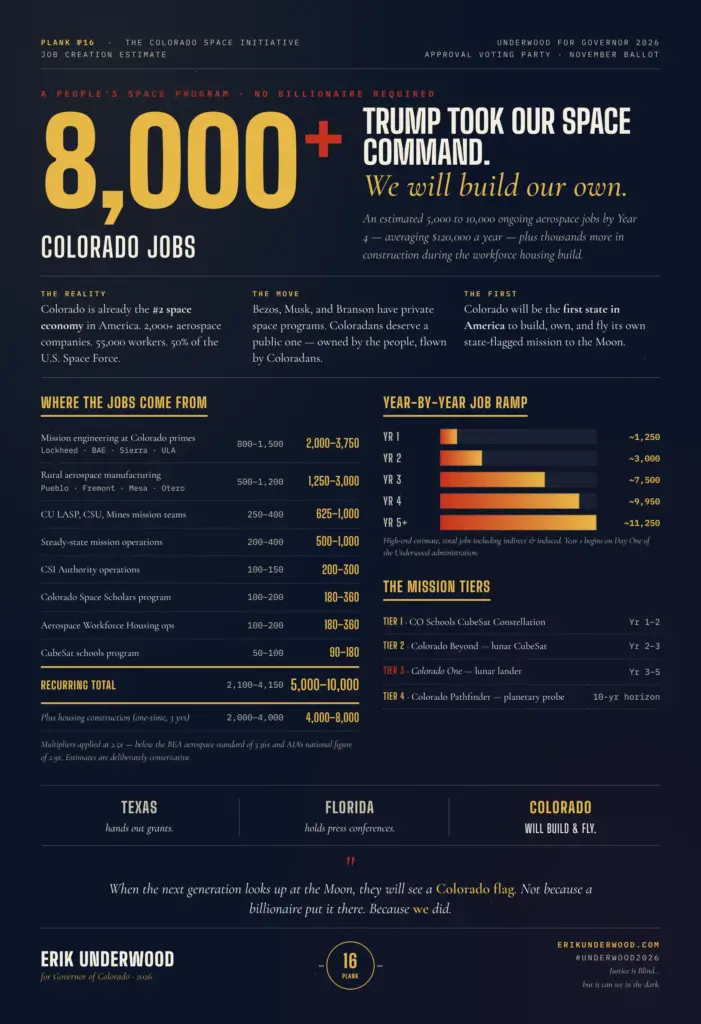
JOB CREATION ESTIMATE
Headline: The Colorado Space Initiative will create an estimated 5,000 to 10,000 ongoing aerospace and aerospace-adjacent jobs by the end of Governor Underwood’s first term, plus an additional 4,000 to 8,000 construction jobs during the workforce housing build-out.
Conservative campaign claim: “At least 8,000 good-paying Colorado jobs — averaging $120,000 a year — without a single billionaire’s permission.”
Methodology
Estimates use the U.S. Bureau of Economic Analysis aerospace product and parts manufacturing employment multiplier of 3.36 (180 supplier jobs + 156 induced jobs per 100 direct jobs). The Aerospace Industries Association’s 2023 economic contribution report finds each direct aerospace job supports 1.9 additional jobs nationally. CSI estimates apply a conservative 2.5x multiplier — below both benchmarks — to ensure all claims withstand fact-check scrutiny.
Bottoms-Up Breakdown (Year 4 — Full Operations)
| Job Category | Direct FTE | Multiplier | Total Jobs |
|---|---|---|---|
| CSI Authority operations | 100–150 | 2.0x | 200–300 |
| Mission engineering at Colorado primes (Lockheed, BAE, Sierra, ULA) | 800–1,500 | 2.5x | 2,000–3,750 |
| CU LASP / CSU / Mines mission program teams | 250–400 | 2.5x | 625–1,000 |
| Rural aerospace manufacturing supply chain | 500–1,200 | 2.5x | 1,250–3,000 |
| Colorado Space Scholars program | 100–200 | 1.8x | 180–360 |
| Aerospace Workforce Housing — permanent operations | 100–200 | 1.8x | 180–360 |
| CubeSat schools program | 50–100 | 1.8x | 90–180 |
| Steady-state mission operations | 200–400 | 2.5x | 500–1,000 |
| TOTAL recurring jobs | 2,100–4,150 | 5,025–9,950 | |
| Aerospace Workforce Housing construction (one-time, 3-yr build) | 2,000–4,000 | 2.0x | 4,000–8,000 |
Year-by-Year Ramp
| Year | Direct Jobs | Total w/ Multiplier |
|---|---|---|
| Year 1 (stand-up) | 250–500 | 600–1,250 |
| Year 2 (CubeSats fly, Colorado Beyond ramp) | 600–1,200 | 1,500–3,000 |
| Year 3 (Colorado One peak engineering + housing build) | 1,500–3,000 | 3,750–7,500 |
| Year 4 (launch ramp + supply chain) | 2,100–4,150 | 5,025–9,950 |
| Year 5+ (steady state, Pathfinder planning) | 2,500–4,500 | 6,250–11,250 |
Sanity Check
Colorado’s existing Job Growth Incentive Tax Credit deals — including the April 2026 “Project Hera” award — generate aerospace jobs at approximately $25,000 in state cost per direct job at $122,000 average salary. CSI’s first-year $40M startup budget, applied at the Project Hera ratio, would generate roughly 1,600 direct aerospace jobs in Year 1 alone. Our published estimates are deliberately more conservative than this benchmark.
What Could Push the Number Higher
- Federal NASA CLPS or DOD partnership cost-share above projections
- Successful capture of relocating Space Command-adjacent contractors
- Acceleration of Colorado Pathfinder (Mars / outer probe) program
- Expansion of Aerospace Workforce Housing beyond initial 2,000-unit target
What Could Compress the Number
- Federal funding instability under continuing-resolution budget cycles
- Contract delays at Colorado primes
- Failure to repeal TABOR (limits on general-fund deployment)
“Donald Trump took our Space Command. He cannot take our future.
Colorado will not wait for Washington. We will not wait for billionaires. We will build our own space program — owned by the people, flown by Coloradans, paid for by jobs we create, and seen by every kid in every county.
When the next generation looks up at the Moon, they will see a Colorado flag. Not because a billionaire put it there. Because we did.”
Erik Underwood Candidate for Governor of Colorado Campaigned in all 64 counties. Approval Voting Party general election ballot, November 2026.
ErikUnderwood.com — #Underwood2026